

|
|
|
| |
|
|
| |
Turning
back the pages...
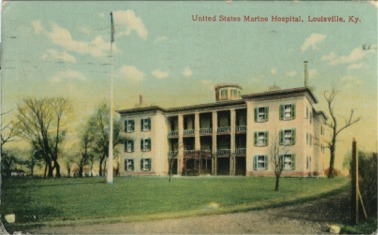
The history of the U.S. Marine Hospital is filled with remarkable challenges, accomplishments and personalities. Looking through our back pages reveals the important role the hospital had in our community’s medical history, river heritage and architectural character.
On this page you'll find some interesting
stories from our past.
|
|
| |
|
|
| |
|
|
| |
GLIMPSES OF THE PAST:
The U.S. Marine Hospital in the 1870s
 |
|
|
|
For five years following the Civil War, the U.S. Marine Health Service ceased active operations. At the War’s outbreak, the MHS operated 28 hospitals across the nation, but during the conflict most had been shut down to serve as war hospitals. Up until this time, the Marine Hospital Service had been a loose organization, without central control, since each operated as an independent facility. In 1861, Louisville’s Marine Hospital ceased serving boatmen and began treating wounded Union soldiers.
One of the great accomplishments of the administration of President Ulysses S. Grant was a complete renovation of the Marine Hospital Service. Under Grant, the Service was organized on a semi-military basis, with central command under the newly-created post of Surgeon General of the United States. A hierarchy was created with physicians given the rank of Surgeon. The service was standardized nation-wide and greater emphasis was placed on physicians’ training and qualifications, science-based treatment of patients, and a growing awareness of the |
|
importance of hygiene and nutrition. A national health library was established and enormous improvements in patient care were achieved.
An important
advancement in the Marine Hospital Service was the
introduction of equal healthcare access to African-Americans
engaged in maritime commerce. Of the three wards located in
Louisville’s U.S. Marine Hospital’s upper two floors, one
was given over to African-American patients, who constituted
approximately one-third of the steamboat crews. While the
wards were racially segregated, both the “White” and
“Colored” patients received the same high standards of care.
Local newspapers from that era provide a
glimpse into the operation of the Marine Hospital Service
and give an idea of the need of the hospital in Louisville.
Within a very few years, the U.S. Marine Hospital in
Louisville served more patients than the St. Louis and New
Orleans hospitals combined. It had become the busiest Marine
Hospital in America. |
|
|
|
Newspaper Clippings: |
27 May 1870
Courier-Journal
At present there are 32 white and 58 colored
patients in the U.S. Marine Hospital on High street,
a larger number than ever before at any one time.
Louisville Commercial
1 January 1871
United States Marine Hospital
It may not be known to many who are entitled to the
benefits of the United States Marine Hospital in
this city, that the law provides that all persons
who find a livelihood on the river, lakes, or seas,
from the captain to the stoker and roustabout (all
classed as seamen), when sick or disabled, are
entitled to care and treatment in the hospital free
of charge. To gain admission into the hospital a
certificate from the officer of the boat, or any
other reasonable proof of the man’s occupation,
presented at the office of Mr. Luse, the surveyor of
the port, will insure his card of admission. During
the year 1,466 patients were admitted, 27 of whom
died.
The following is the official report of the surgeon
of the hospital for December (1870):
NUMBER OF PATIENTS REMAINING LAST
DAY OF NOVEMBER (1870)
Whites………………………51
Colored……………………..44
Total………………...95
ADMITTED DURING THE MONTH
Whites………………………84
Colored……………………..46
Total………………...130
No. patients remaining and admitted….225
DISCHARGED DURING THE MONTH
Whites………………………60
Colored……………………..33
Total………………...93
DIED DURING THE MONTH
Whites………………………3
Colored……………………..2
Total………………...5
REMAINING THE LAST DAY OF THE MONTH
Whites……………………..77
Colored……………………50
Total……………….127
T.J. Griffith
Surgeon in charge, 363 West Jefferson Street, between Ninth and Tenth
Louisville
Commercial
1 January 1871
Wm. Trice, a colored deck-hand on the steamer United
States, had his knee crushed with a hogshead of
tobacco yesterday, while assisting in loading He was
taken to the Marine Hospital. The limb will probably
have to be amputated.
Louisville Commercial
8 January 1871
George C. Smith, formerly a roustabout on the steamer N. J. Bigler, was taken to the United States Marine Hospital on Friday, suffering from mania-a-potu and exposure, and died yesterday. John Moss, a river man, formerly on the Tarascon, was taken to the same hospital with frozen feet. The stoppage of the boats on the river has thrown a number of men out of employment who take no care of themselves, and drink to
|
stupor, when they lie down on the streets, and before they are picked up are half frozen, and receive injuries from which they die.
Louisville Commercial
10 January 1871
Barry Tallman, formerly of the steamer Mary Huston,
had his foot crushed yesterday, and was sent to the
United States Marine Hospital.
Louisville Commercial
25 January 1871
Henry Thompson had his feet terribly scalded by the
playfulness of the cook on the steamer Shannon.
George Winn, while rolling a hogshead of tobacco on
the Morning Star, had his leg crushed. Both Thompson
and Winn were sent to the United States Marine
Hospital.
Louisville
Commercial
31 January 1871
Wm. Fuller, who has run as a pilot on the Western
rivers for a quarter of a century, and who was for
many years past a pilot between Cincinnati and
Maysville, died at the Marine Hospital yesterday of
dropsy. He had been operated upon three times, each
time feeling great relief, but the disease finally
caused his death.
Louisville Commercial
13 August 1871
The U.S. Marine Hospital
A religious order of the Catholic Church, known as the Sisters of Mercy, has had the management of the United States Marine Hospital, in this city, for more than two years, and have again re-leased it for a term of years. Dr. Thomas J. Griffiths remaining as surgeon in charge. When the Sisters took the hospital they started with eight patients, and now it averages nearly one hundred marine patients, besides a number of private patients. The management of the hospital has been such that sick marines from the Western rivers and lakes have been sent to it for treatment. The discipline in the hospital has been equal to any naval hospital in the country, and has met with the favorable notice of the Treasury Department. The duties of the surgeon in charge have been so largely increased that Dr. Griffiths has been authorized by the department to employ an assistant, and has appointed Dr. Oliver H. Luse, a young gentleman of great promise, who graduated last winter at one of the medical schools of this city.
We congratulate Dr. Luse on his rapid progress in his profession, and believe that Dr. Griffiths will find in him a faithful, energetic and capable assistant. Seventeen Sisters of Mercy now comprise the force, performing all the duties of the management of the hospital, which has become in two years the most prominent Government hospital west of the mountains.
|
To accommodate the large increase of patients,
additions will be made to the hospital, and
water-pipes will be extended through the building.
We are justly proud of this institution in our
midst, and feel that it can take rank with any naval
hospital in the country.
17 February 1872
Courier-Journal
Woman in the Marine Hospital
Mary Jane Grant, a colored chamber-maid, was admitted yesterday to the United States Marine Hospital from the steamer Camelia. She is the only female that has applied for admission to that institution within three years. The managers, however, extend a welcome to all “marines,” whether they are black or white, foreign or domestic, Federal or Confederate. The Sisters of Mercy have charge there and are ever ready and willing to nurse suffering humanity, wheresoever and in whomsoever they find it.
4 February 1876 Courier-Journal The U.S. Marine Hospital With the 1st of January the lease of the Sisters of Mercy on the United States Marine Hospital, in this city, expired, and the Government took charge of the building, turning it into a class one of marine hospitals. It had belonged to class two, which is composed of all hospitals leased by the Government. The Sisters of Mercy have been in charge of the Marine Hospital in this city since 1869, and have conducted it in an excellent manner. Hereafter it will be under the control of Dr. Tom Griffiths, the surgeon and his assistant, Dr. W. H. Long, who will, through Col. Luse, surveyor of customs, furnish all the supplies and employ the persons necessary to the establishment. Three of the Sisters of Mercy have been retained for nurses and other purposes. The Marine Hospital is one of the largest in the country and adds many thousand dollars per year to the coffers of Louisville people. The surgeon and his assistant are gentlemen well known in the community, and thoroughly able to take care of the establishment. Louisville City Hospital Preston and Chestnut Streets.
REPORT ON LOUISVILLE’S PUBLIC HEALTH: Two Hospitals Serve More than 100,000 citizens In 1870, the population of Louisville, Kentucky reached 101,000 for the first time. Despite this large population, only two medical facilities existed. The U.S. Marine Hospital (located in the Portland community) served boatmen and federal employees. The Louisville City Hospital (originally known as the Louisville Marine Hospital) cared for the general public.
|
Located at Preston and Chestnut streets, the City Hospital admitted only white patients. Then, as now, the building also served as a teaching hospital and was associated with the University of Louisville School of Medicine.
Mortuary Report
The following is the mortuary report for the Week ending December 31, 1870:
LOUISVILLE, KY.
HEALTH OFFICE
December 31, 1870
Accident ...2
Bronchitis ...1
Consumption ...5
Congestion of brain ...1
Convulsions ...2
Colic ...1
Croup ...2
Delirium Tremens ...1
Fever, puerperal ...1
Fever, typhoid ...1
Gun-shot wound ...1
Knife wound ...1
Old age ...2
Paralysis ...1
Pneumonia ...2
Premature birth ...1
Rheumatism ...2
Scrofula ...1
Still born ...5
Teething ...1
Trismus ...1
Unknown ...
TOTAL ...37
SEX
Male ...24
Female ...13
COLOR
White ...23
Black ...14
AGE
Under 3 years ...15
3-6 years ...1
6-10 years ...0
10-20 years ...3
20-30 years ...5
30-40 years ...3
40-50 years ...4
50-60 years ...3
60-70 years ...0
70 and over ...3
NATIVITY
America, 27; Ireland, 5; Germany, 3; England, 1; Scotland, 1
Eastern District ...23
Western District ...14
Without medical attention ...7
C.B. Blackburn, M.D.
Secretary, Board of Health
Coroner’s Report
Sept. 5 through December 31, 1870
Suicide from poison, male 1, female 1 ...2
Suicide from hanging ...1
Bursting blood-vessel ...3
Crushed to death in clay-bank, white 1, colored 1 ...2
Drowned, male 4, female 1, white 4, colored 1 ...5
Run over by wagon ...1
Run over by street-car, white 1, colored 1 ...2
Heart disease, males 5, females 3, whites, 7, colored 1 ...8
Old age, males 1, females 1 ...2
Intemperance, males 2, females 1, white 2, colored 1 ...3
Infanticide, males 3, females 2; white 1, colored 4 ...5
Murdered, males 7, white 5, colored 2 ...7
Skull fractured while blasting rock ...2
Falling in pit ...1
Burning, females 2, white 1, colored 1 ...2
Falling and breaking neck ...2
Concussion of brain ...2
Kicked by mule ...1
Causes known, white 1, colored 2 ...3
By explosion of boiler ...1
Total ...55
LOUISVILLE CITY HOSPITAL
Report of pay and charity patients admitted, discharged, died and born at Louisville City Hospital during the month of December 1870:
No. patients remaining November 30, 1870 ..118
No. patients admitted during December, 1870 ...94
TOTAL ...212
No. patients discharged ...60
No. patients died ...8
No. patients remaining December 31, 1871 ...144
TOTAL ...212
No. dispensary patients prescribed for and medicines furnished ...100
No. children born ...4
Mrs. E. H. Geary, Superintendent |
|
 |
|
|
|
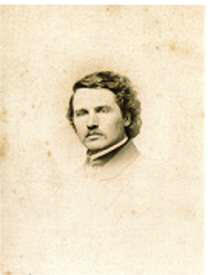
Dr. David J. Griffiths (1830-1885) |
|
The Griffiths Brothers
U.S. Marine Hospital’s
Surgeons-in-Charge In the period
following the Civil War, the U.S. Marine Hospital at
Louisville was commanded by three remarkable local
physicians. Dr. David, Dr. Thomas, and Dr. George Washington
Griffiths each served as Surgeon-in-Charge of the maritime
hospital.
Natives of Wales, the Griffiths family moved to America in
1841. All three brothers studied medicine in Louisville and
each established popular and successful medical practices.
Ardent Unionists, at the outbreak of the Civil War, each
made their contributions to the war effort and to medical
service in Louisville.
The Portland neighborhood recognized their contributions to
the community by naming Griffiths Avenue, just a few blocks
south of Portland Avenue, to honor their service.
Medical service, and a commitment to the Marine Hospital,
was a family tradition. In later years, Dr. William
Griffiths, a son of Dr. George W., also became a physician
at our hospital. |
|
|
|
|
Dr. David J. Griffiths held the important position
of Medical Director for General Philip Sheridan’s Division of
the Army of the Cumberland and the Army of the Potomac. He
earned a reputation as one of the finest surgeons in the U.S.
Army, and was a trusted and important part of Sheridan’s
command.
Dr. David’s heath was shattered by exposure and the stress of
the War and he retired in late 1864. In 1869, he was named
Surgeon-in-Charge of the Louisville U.S. Marine Hospital and was
given the responsibility of re-opening the hospital. Our
hospital was closed in 1863, and boatmen were transferred to the
old Louisville Marine Hospital. Dr. David Griffiths, and the
Sisters of Mercy, opened the hospital and began to again serve
boatmen.
He only served in this position for three months,
when he became paralyzed and blind. He was forced to retire and
lived his life as an invalid. At the end of his life, he lived as a patient in
the hospital he helped resurrect. |
|

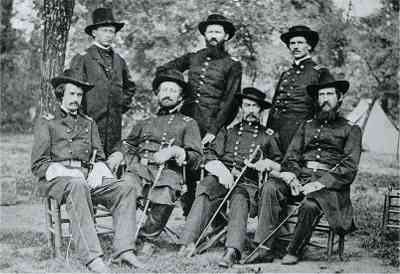
PHOTO Courtesy of Cynthia Tesser
Dr. David J. Griffiths is shown standing at
far right of the photo.
Seated in front row (second from left)
is Major General William Rosecrans, commander of the Army of the
Cumberland.
To his right side is Gen. Philip Sheridan, who would
soon take over command of the Cumberland Army following the
Battle of Stones River. |
|
|
|
|
|

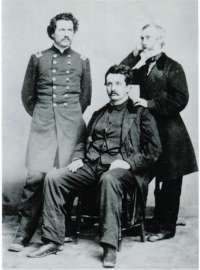
PHOTO courtesy of Cynthia Teller
Dr. David J. Griffiths
(standing on left),
and his brother
Dr. Thomas J. Griffiths (seated),
are shown
with Dr. Peck.
This is the only known photo
of Dr. Thomas
Griffiths. |
|
Dr. Thomas Griffiths
(1826-1884)
Dr. Thomas Jones Griffiths took over command of the U.S.
Marine Hospital after illness forced the retirement of Dr.
David Griffiths in 1869. Dr. Thomas would become the
hospital’s most important medical professional and set the
direction for decades of health care service.
During the Civil War, Dr. Thomas remained a civilian and
served as supervising physician for several Louisville
military hospitals. At the peak of the war effort,
Louisville hosted 21 General Military Hospitals, including
the very large 800 bed hospital at Parks Barracks, on the
future campus of the University of Louisville.
Working with the Sisters of Mercy, Dr. Thomas Griffiths made
the hospital in Louisville the largest of all inland marine
facilities. At his retirement in 1877, our hospital served
more patients annually than those in St. Louis and New
Orleans combined.
Dr. George
Washington Griffiths
(1840-1908)
The youngest of the Griffiths brothers, Dr. George W. found
his medical studies interrupted by the outbreak of the Civil
War. He served with great distinction as Captain of the
Second Kentucky Cavalry. Wounded at Chickamauga, and later
captured, he was exchanged and served until the end of the
War.
At the end of the War, he was offered a commission as First
Lieutenant in the Seventh Cavalry by General Ulysses S.
Grant. He declined the commission and returned to medical
studies. As a result, he was not serving with Gen. Custer
when his command was destroyed at the Little Big Horn.
Dr. George W. became a prominent Louisville physician and
served as Surgeon at the Marine Hospital. He also served as
President of the Louisville Board of Aldermen for twelve
years and chief physician for the L&N railroad. His son, Dr.
William Griffiths, continued the family tradition and served
in the Marine Hospital. |
|
|
|
|
|
|
| |
|
|
|